Getting started in model railroading can feel confusing when every search introduces another scale, track system or unfamiliar term. You might know exactly what appeals to you—a freight train passing through a miniature town—but have little idea what to buy first.
The best starting point is a small, manageable project with a clear purpose. Decide where your railroad will go, what you want your trains to do and how much you can spend before collecting equipment.
This model railroading guide for beginners walks through those first decisions. For detailed construction instructions, follow our guide to building a model train layout.
Affiliate disclosure: This article contains affiliate links. If you purchase through them, we may earn a commission at no additional cost to you.
Prefer to learn from a structured guide? Explore the Beginners Guide to Model Trains. The seller describes a digital resource covering layout planning, trackwork, wiring and scenery. Check the current contents and purchase terms before ordering.
What Is Model Railroading?
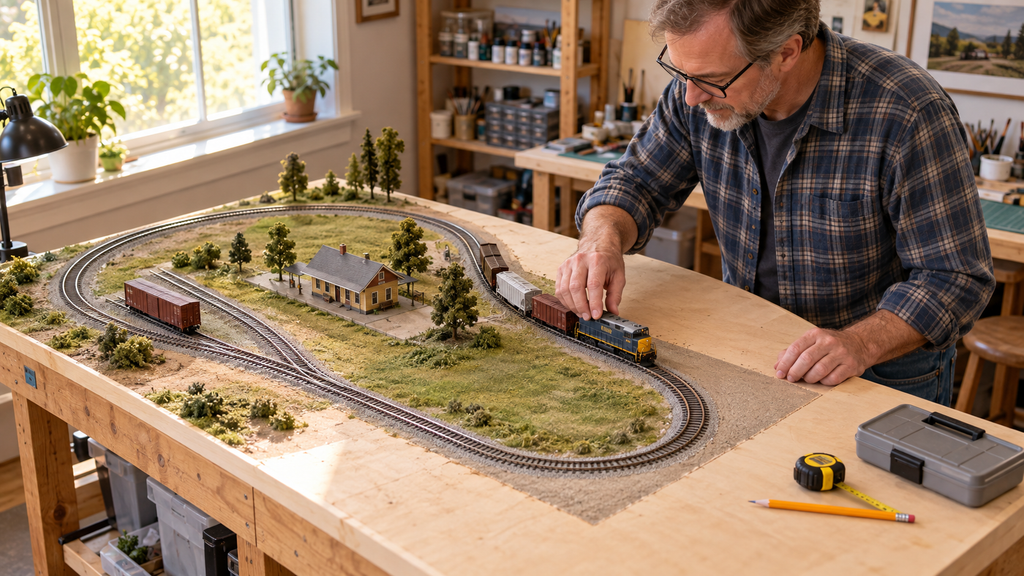
Model railroading combines running miniature trains with creating the setting around them. Depending on your interests, that might include building scenery, assembling structures, planning freight movements or reproducing part of a real railroad.
A layout is the track arrangement and its supporting base, often with scenery and buildings.
You do not need to enjoy every aspect equally. Some hobbyists concentrate on realistic scenery. Others prefer operating trains or collecting locomotives. Your first project should reflect what attracts you to the hobby.
For example:
- If you enjoy watching trains travel through scenery, consider a continuous-running layout.
- If you like puzzles and purposeful movements, explore a switching layout.
- If you enjoy constructing miniature scenes, start with a small scenic section that can become part of a larger railroad.
1. Decide What You Want From Your First Layout
Before choosing equipment, write a short description of your goal.
Something as simple as this is useful:
“I want a compact freight layout with one locomotive, a few cars and a small town scene.”
That statement gives you a way to judge purchases. A locomotive, building or track arrangement either supports your project or adds a distraction.
Consider these questions:
- Do you want continuous running, switching operations or both?
- Do you prefer freight trains, passenger trains or a particular railroad?
- Will the layout be permanent, portable or stored between sessions?
- Are you building alone or sharing the hobby with family?
- Would you rather finish a compact project or work gradually on something larger?
You can revise your preferences later. For now, choose a first project that is achievable.
2. Measure Your Space Before Buying Track
Measure the available area and sketch the room. Include doors, furniture and the space you need to move around the layout.
The layout’s base is only part of its footprint. You also need access to operate trains, clean track and recover a derailed car.
Ask yourself:
- Can I reach every section of track?
- Can I work underneath the base?
- Will the layout obstruct a doorway or cupboard?
- Can it be moved if the room’s use changes?
- Will tunnels or buildings block access?
A table pushed against a wall may leave its far side difficult to reach. A narrow shelf might use the room more effectively, depending on the operations you want.
Compare the options in our guides to model train layouts for small spaces and model railroad shelf layouts.
3. Choose a Scale That Suits Your Project
Scale describes how much smaller the model is than the real object. Gauge describes the distance between the rails. The terms are related, but they do not mean the same thing.
For a first indoor layout, HO and N are useful options to compare.
| Consideration | HO scale | N scale |
|---|---|---|
| Model size | Larger than N | Smaller than HO |
| Space for the same scene | Requires more room | Allows a more compact scene |
| Handling | Larger parts may be easier to handle | Smaller parts require more care |
| Layout planning | Check curves against your chosen equipment | Check curves against your chosen equipment |
| Main question | Does the desired plan fit comfortably? | Are you comfortable handling the smaller models? |
Neither is automatically the best choice for every beginner.
If possible, look at both in person. Handling a freight car and seeing a locomotive run can help you judge the size more effectively than photographs.
Read HO vs N scale for beginners and our model train scale guide before committing.
4. Set a Budget for the Whole Project
A locomotive or starter set is only one part of the cost.
Your initial budget may also need to cover:
- A suitable base or benchwork.
- Track and turnouts.
- A compatible controller or power supply.
- Wiring and connections.
- Basic tools.
- A few cars.
- Initial scenery materials.
Separate what you need to run trains from what you would like to add later.
For example, you might complete the base and track first, then add a station and scenic landscape over several months.
Keep a simple purchase list:
| Purchase | Needed for the first stage? |
|---|---|
| Compatible locomotive and controller | Yes |
| Track for the initial plan | Yes |
| Stable supporting base | Yes |
| Extra locomotives | Usually later |
| Detailed buildings throughout the layout | Later |
| Extensive lighting and scenic effects | Later |
See model train layout costs for budget planning and model railroading on a budget for ways to control spending.
5. Choose a Simple Track Plan
A good beginner plan is one you can understand, build and maintain.
Three arrangements are worth exploring:
A Continuous-Running Loop
A loop allows trains to circulate without reversing at the end of the track. It suits someone who enjoys watching trains run.
Check that the curves accommodate the locomotives and cars you intend to use.
A Loop With a Few Sidings
Adding a siding or two can create places to park cars or serve a small industry.
Keep additions purposeful. Every turnout adds cost and another area to install and test.
A Shelf Switching Layout
A shelf layout can focus on moving cars between industries. It may fit a narrow space well, although many designs do not offer continuous running.
Choose the operating experience you want before choosing the track arrangement.
Our model railroad track-plan guide explains the main options. For specific starting points, explore 4×8 HO scale track plans and small N scale layouts.
Want help connecting the planning decisions? Take a look at the Beginners Guide to Model Trains. Review its advertised lessons to see whether they address the stages you need help with.
6. Check Equipment Compatibility
Matching the scale is necessary, but it does not settle every compatibility question.
Before purchasing, check:
- The locomotive’s power and control requirements.
- The curve requirements of the locomotive and cars.
- Whether the track pieces connect directly or need adapters.
- Coupler compatibility.
- What the controller or starter set actually includes.
“DCC-ready” and “DCC-equipped” are different descriptions. Do not assume a locomotive already has a decoder because its listing says it is ready for one.
For used equipment, ask about its condition and whether it has been tested. A low purchase price may be less attractive if repairs or missing parts are needed.
7. Understand DC and DCC Before Choosing Control
DC and DCC are two approaches to controlling model trains.
With conventional DC, a controller varies the track supply to control a train. Independently controlling several locomotives can involve dividing the layout into electrical sections.
With DCC, compatible decoders receive commands addressed to individual locomotives. This can support independent operation of multiple trains on shared track.
The choice depends on your operating goals, equipment and budget. DCC still requires appropriate wiring and protection.
Read DC vs DCC for beginners before buying a control system, and follow the instructions supplied with your equipment.
8. Buy Tools for the Next Job
Avoid buying a large collection of specialist tools before you know which tasks your project requires.
Start by reviewing the instructions for your chosen track, base and kits. Then buy the tools needed for those jobs.
Common tasks include measuring, cutting, fastening, handling small parts and making electrical connections.
Our model railroad tools guide can help you build a practical shopping list.
9. Test Before Adding Permanent Scenery
Once you begin construction, make running tests part of the process.
Test the actual locomotive and cars you plan to use. Check curves, turnouts and connections in both directions.
If a train repeatedly stops or derails at one place, investigate it while the track is accessible. Buildings, ballast and scenic terrain can make later adjustments harder.
After the base and track are working reliably, develop one scenic section at a time. Our beginner scenery guide provides a starting point.
Common Beginner Mistakes
Several early choices can make a first layout unnecessarily difficult:
- Buying equipment before measuring the space.
- Choosing a plan with too many features.
- Overlooking access to the back or centre.
- Spending the whole budget on trains.
- Assuming every same-scale item works together.
- Adding scenery before resolving running problems.
- Expanding before completing a usable first stage.
Read model railroading mistakes beginners should avoid for a closer look.
Frequently Asked Questions
Do I need a large room to start model railroading?
No. A compact table or narrow shelf can be a useful starting point. The space available will influence the scale, track arrangement and type of operation.
Should I buy a starter set?
A starter set can be convenient, but check that its equipment suits your intended layout. Confirm what is included, its control system and whether the track can be expanded as planned.
Is HO or N scale better for beginners?
Both can suit beginners. Compare your available space, handling comfort and preferred trains. Seeing the equipment in person can help you decide.
Do I need electrical experience?
You need to learn the requirements of your chosen system and follow its instructions. Start with a manageable arrangement and seek experienced help when a connection or component is unclear.
Should I build scenery immediately?
Plan scenery early, but make sure the base and track function reliably before adding details that restrict access.
Your First Project Starts With a Plan
You do not need a room full of equipment to begin. You need a measured space, a clear goal and compatible equipment for a manageable first layout.
Write down what you want to build, compare scales and choose a simple track arrangement. Then move into construction with a realistic budget and a plan for testing.
Your next step is our complete guide to building a model train layout.
Prefer a paid guide alongside your project? Explore the Beginners Guide to Model Trains. Check the current checkout terms, including any trial membership and recurring charges, before purchasing.